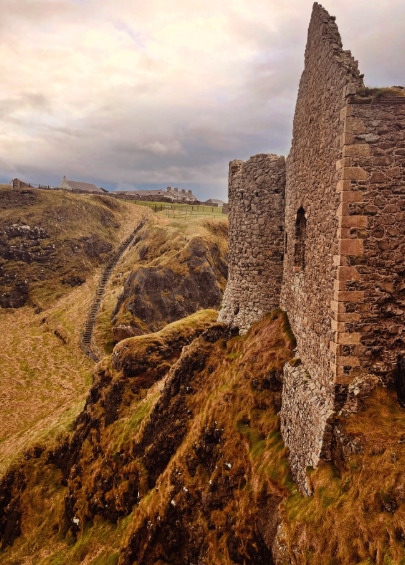
A cliff-edge ruin missing its kitchen tends to invite stories, and Dunluce Castle has collected more than most. One of them is documented history — a storm that took part of the building into the Atlantic in 1639. The others are folklore, passed down through generations of families who lived along this stretch of the Antrim coast. Here's what's verifiable, what's legend, and where to find both on-site.
The Night the Kitchen Fell Into the Sea (1639)
Of everything associated with Dunluce Castle, this is the one grounded entirely in documented history rather than folklore. In 1639, during a severe storm, part of the castle's kitchen — built directly over the cliff edge on the seaward side — collapsed into the Atlantic below. Several servants working inside at the time were killed.
The event marks a genuine turning point in the castle's story. Within decades, the MacDonnell family had largely abandoned Dunluce as a full-time residence, and the site began its slow slide into the ruin it remains today. It's worth pausing on this before treating the rest of the castle's stories as equally distant: the kitchen collapse isn't legend dressed up as fact — it's a recorded historical event with real consequences for the site's fate.
Why the kitchen was built over the cliff at all
Building directly over a sheer drop looks reckless in hindsight, but it reflects a real defensive logic. The natural cliff face did the work a wall would otherwise have to do — no attacking force could approach from the sea side, so builders could put habitable rooms right up to the edge without needing to thicken the masonry for defense on that side. The same logic explains the castle's stone bridge across the landward chasm: the site's natural geography was doing as much defensive work as anything the McQuillans or MacDonnells built by hand. The 1639 storm exposed the one real cost of that approach — a structure with no margin for error against the sea it was built to use as a wall.
The Banshee of Maeve Roe
The story as told locally
The best-known Dunluce Castle legend concerns Maeve Roe, daughter of a MacQuillan lord, said to have been locked in the castle's turret after refusing an arranged marriage. According to the story, her lover reached her by boat and helped her escape from the tower — though versions of the tale differ on exactly how the escape unfolds, and on what became of her afterward. Local tradition holds that her cry can still be heard from the turret on stormy nights, giving Dunluce its resident banshee.
The McQuillan-MacDonnell rivalry behind the story
The legend's marriage-and-refusal framing isn't incidental — it echoes the real, documented way Dunluce itself changed hands. The McQuillans and MacDonnells fought over control of this stretch of coast for decades, and one account of how the MacDonnells eventually gained the castle involves a MacQuillan daughter, Evelyn, marrying into the rival family rather than being forced apart from a suitor. A legend about a daughter locked away for refusing marriage sits in exactly the same territory as a documented history where a daughter's marriage determined who controlled a castle. That doesn't prove Maeve Roe existed, but it explains why a story shaped like this one took root here specifically, rather than at some unrelated site.
What we actually know versus legend
There's no historical record naming a Maeve Roe among the McQuillan family, and the story exists only in oral tradition rather than any surviving document from the period. That doesn't make it worthless — legends like this tend to encode something real about how women's marriages functioned as political and economic transactions within families like the McQuillans and MacDonnells, even if the specific character is invented or embellished over generations of retelling.
The Sea Cave Beneath the Castle
Below the castle, at the base of the cliff, sits a sea cave that's fed a separate strand of local folklore involving mermaids and enchanted sea creatures. The cave itself is real and visible from certain points along the cliff path, even if the folklore built around it is not. Its presence directly beneath the ruins is part of why the site has accumulated so many overlapping legends — a genuinely dramatic piece of coastal geology sitting right underneath a genuinely dramatic ruined castle tends to generate stories regardless of what actually happened there.
Coastal caves like this one were a practical concern as much as a folkloric one for the families who lived above them — sea access at the base of a cliff is a security risk as much as a curiosity, and it's reasonable to assume the MacDonnells were as aware of the cave's existence for defensive reasons as any storyteller was for narrative ones. The mermaid folklore layered on top came later, in the way that unexplained coastal geology tends to attract stories once the practical reason for noticing it in the first place is forgotten.
Why the Legends Persist
Dunluce's real history already supplies enough drama that the folklore almost feels redundant — a clan feud settled by marriage, a recapture pulled off with a basket lowered from a window, a Spanish Armada wreck whose cannons ended up mounted on the gatehouse. Add a fictional banshee and a mermaid cave, and the site reads less like one story and more like a place several generations of storytellers kept adding to.
This isn't unique to Dunluce — other Antrim coast sites with a similar history of clan conflict, like Carrickfergus Castle further down the coast, have accumulated their own ghost stories over time. What sets Dunluce apart is how directly its folklore ties back to a specific, documented event: most castle ghost stories float free of any particular date, but Dunluce's most famous non-legendary story — the kitchen collapse — has an actual year attached to it, which lends a kind of borrowed credibility to everything else associated with the site.
That layering is also part of why Dunluce made such a natural fit as a film location — its brooding, historically loaded silhouette needed no embellishment to read as an ancient seat of power on screen, which is exactly what happened when it became Castle Greyjoy in Game of Thrones.
Visiting the Legend Sites Yourself
If you want to see where each of these stories is actually set, rather than just reading about them, here's where to look on-site.
| Legend | Where to look | What you'll actually see |
|---|---|---|
| Kitchen collapse (1639) | North side, cliff edge | A clear structural break in the masonry where the kitchen once stood |
| Maeve Roe's turret | Upper tower section | The turret room, with restricted access near the cliff edge |
| Sea cave / mermaid folklore | Cliff path, before the entrance bridge | A visible cave opening at the base of the cliff, weather permitting |
The Bigger Picture
None of this folklore needs to be true to be worth knowing before a visit — it changes what you notice once you're standing in the ruins. The kitchen collapse gives the northern cliff edge a weight it wouldn't otherwise have; the Maeve Roe story gives the turret a narrative beyond its stonework; the sea cave gives the cliff path a reason to slow down and look over the edge rather than straight ahead toward the entrance. Compare that against a first-time visit with no context at all, and it's a meaningfully different experience of the same 45 minutes on-site.
For the full, sourced timeline behind these stories — the McQuillan and MacDonnell clans, the 1584 recapture, and the Spanish Armada connection — see our complete Dunluce Castle history page. And if you're still deciding whether the trip is worth it at all, we've written directly about that question in Is Dunluce Castle Worth Visiting?